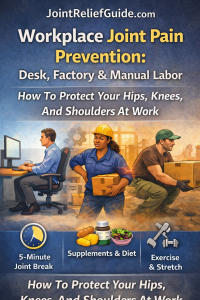
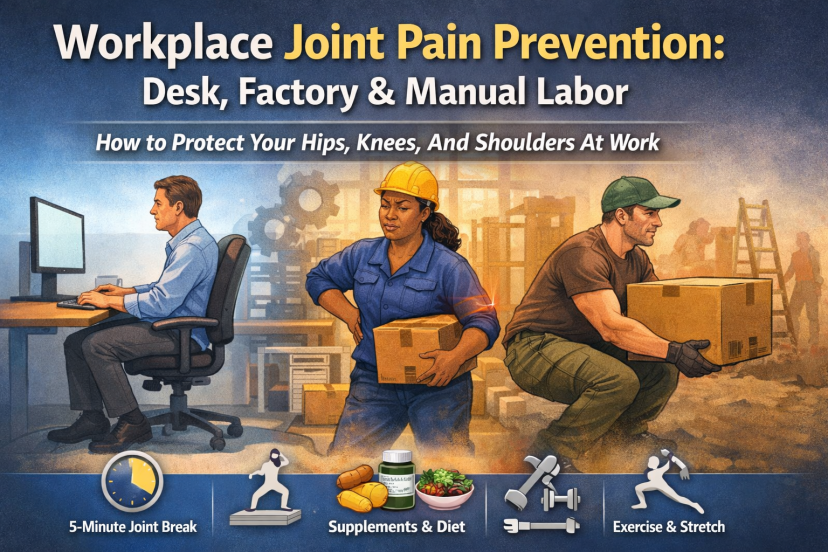
Workplace Joint Pain Prevention: Desk, Factory & Manual Labor – How To Protect Your Hips, Knees, And Shoulders At Work
🦵 You’re Not Weak—Your Joints Are Overworked
🧑 If your hips feel stiff after sitting all day…
🦵 If your knees ache after long shifts…
🧘♀️ If your shoulders burn by the end of your workday…
You’re not broken — your joints are simply doing more than they were designed to do.
Millions of Americans over 40 deal with daily joint pain caused by work routines. Whether you sit at a desk, stand in a factory, or lift on a job site, your joints take the hit.
The good news?
With smart workplace joint pain prevention for hips, knees, and shoulders, you can reduce pain, improve mobility, and protect your joints for the long run — without quitting your job.
This guide covers:
-
Desk worker joint pain prevention
-
Factory worker joint relief tips
-
Manual labor joint health for knees and hips
-
A simple “5-minute joint health break at work.”
-
Employer-friendly joint safety checklists
Let’s protect your joints — starting today.
❓ Why Work Causes Joint Pain In Hips, Knees, And Shoulders
Your joints love movement — but not the same movement all day.
Common Workplace Joint Stressors
-
Long sitting or standing
-
Repetitive motions
-
Heavy lifting
-
Poor posture
-
Hard floors
-
Bad shoes
-
Weak muscles supporting joints
Over time, this leads to:
-
Cartilage wear
-
Inflammation
-
Muscle tightness
-
Reduced joint fluid
-
Stiffness and pain
That’s why workplace joint pain prevention for hips, knees, and shoulders is about balance — moving more, moving better, and recovering smarter.
💺 Desk Worker Joint Pain Prevention
Desk jobs may look easy, but sitting is one of the worst things for joints.
🦵 Desk Job Joint Risk Areas
-
Hips: Tight hip flexors from sitting
-
Knees: Poor circulation, stiffness
-
Shoulders: Rounded posture, neck strain
💪 Ergonomic Joint Relief At Work
Chair Setup
-
Hips slightly higher than knees
-
Feet flat on the floor
-
Back supported
-
Screen at eye level
Keyboard & Mouse
-
Elbows at 90°
-
Shoulders relaxed
-
Wrists neutral
🌿 Desk Worker Joint Pain Prevention Routine
Every 30–45 minutes:
-
Stand up
-
Walk 1–2 minutes
-
Roll shoulders
-
Stretch hips
Simple hip stretch:
-
Stand
-
Step one foot back
-
Bend the front knee
-
Feel a stretch in the back of the hip
🦵 Mini Desk Exercises
-
Seated knee lifts
-
Ankle circles
-
Shoulder shrugs
-
Neck turns
These small moves protect you from big joint problems later.
🏭 Factory Worker Joint Relief Tips
Factory work often means long hours of standing, bending, and repeating motions.
🦵 Factory Job Joint Risk Areas
-
Knees: Standing on hard floors
-
Hips: Repeated bending
-
Shoulders: Lifting, reaching
💪 Ergonomic Joint Relief Work Tips
-
Use anti-fatigue mats
-
Wear cushioned shoes
-
Rotate tasks when possible
-
Use carts instead of carrying
-
Keep loads close to your body
🌿 Factory Worker Joint Relief Routine
Before shift:
-
3 minutes walking
-
Hip circles
-
Arm swings
During shift:
-
Change position often
-
Shift the weight side to side
-
Take micro-breaks
After shift:
-
Gentle stretching
-
Ice sore joints
-
Warm shower
🧱 Manual Labor Joint Health: Knees, Hips, And Shoulders
Manual labor is tough — but your joints can be tougher if you train them right.
🦵 Manual Labor Joint Risk Areas
-
Knees: Squatting, climbing
-
Hips: Heavy lifting
-
Shoulders: Overhead work
💪 Safe Lifting For Joint Health
Always:
-
Bend at the hips and knees
-
Keep your back straight
-
Hold the load close
-
Use legs, not back
-
Don’t twist while lifting
🌿 Manual Labor Joint Health Routine
Morning warm-up:
-
March in place
-
Arm circles
-
Hip hinges
-
Bodyweight squats
On the job:
-
Take breath breaks
-
Change posture
-
Stretch between tasks
After work:
-
Foam roll
-
Stretch hips and calves
-
Ice sore areas
⏱️ The 5-Minute Joint Health Break At Work
You don’t need a gym — just 5 minutes.
💪 5-Minute Joint Health Break
I Minute 1: Walk
-
Walk or march
-
Swing arms
II Minute 2: Hips
-
Hip circles
-
Standing lunges
III Minute 3: Knees
-
Mini squats
-
Heel raises
IV Minute 4: Shoulders
-
Shoulder rolls
-
Arm swings
V Minute 5: Stretch
-
Hamstrings
-
Hips
-
Chest
Do this 2–3 times daily for real workplace joint pain prevention for hips, knees, and shoulders.
🌿 Natural Joint Support At Work
💊 Supplements For Joint Health
Common U.S. options:
-
Glucosamine & chondroitin
-
Turmeric (curcumin)
-
Omega-3 fish oil
-
Collagen peptides
These may:
-
Reduce inflammation
-
Support cartilage
-
Improve mobility
Always talk to a doctor if you take medications.
🥗 Anti-Inflammatory Diet For Joint Pain
What you eat affects how your joints feel.
🌿 Joint-Friendly Foods
-
Fatty fish
-
Olive oil
-
Nuts
-
Berries
-
Leafy greens
-
Beans
🚫 Limit These
-
Sugar
-
Fried foods
-
Soda
-
White bread
-
Processed snacks
Hydration matters too — joints need fluid to move smoothly.
💪 Strength Training For Workplace Joint Pain Prevention
Strong muscles protect weak joints.
⭐ Best Exercises
Hips Exercises
-
Glute bridges
-
Step-ups
-
Lunges
Knees Exercises
-
Squats
-
Leg raises
-
Wall sits
Shoulders Exercises
-
Resistance band rows
-
Wall push-ups
-
Shoulder raises
2–3 times per week is enough to see results.
🧑💼 Employer-Friendly Joint Health Checklist
✅ For Desk Work
-
Adjustable chairs
-
Screen at eye level
-
Break reminders
-
Standing desks
✨ For Factory Work
-
Anti-fatigue mats
-
Task rotation
-
Lifting aids
-
Safety training
🙌 For Manual Labor
-
Proper tools
-
Team lifting
-
Break schedules
-
Stretch programs
Healthy workers = fewer injuries and better productivity.
🦵 Signs Your Joints Need More Care
Watch for:
-
Morning stiffness
-
Swelling
-
Grinding or popping
-
Weakness
-
Pain that lasts for days
These mean your joints are asking for help.
🚑 When To See A Doctor
See a doctor if:
-
Pain lasts more than 2–3 weeks
-
Swelling is severe
-
You can’t move a joint normally
-
Pain wakes you at night
-
Injury caused sudden pain
Early care prevents long-term damage.
❓ FAQs: Workplace Joint Pain Prevention
1. What Is The Best Workplace Joint Pain Prevention For Hips, Knees, And Shoulders?
Moving often, good posture, strength training, stretching, and joint-friendly habits.
2. How Often Should I Move At Work?
Every 30–45 minutes is ideal.
3. Are Standing Desks Good For Joint Pain?
Yes — if you alternate sitting and standing.
4. What Shoes Help Joint Pain At Work?
Cushioned, supportive shoes with good arch support.
5. Do Supplements Really Help Joints?
Many people benefit from glucosamine, turmeric, and omega-3s.
6. Can Stretching Reduce Joint Pain?
Yes — especially hips, hamstrings, calves, and chest.
7. Is Joint Pain A Normal Part Of Aging?
Some changes are normal, but pain is not something you must accept.
🌟 Conclusion: Your Work Shouldn’t Break Your Body
Your job matters — but so does your health.
With smart workplace joint pain prevention for hips, knees, and shoulders, you can:
-
Work longer with less pain
-
Move better every day
-
Protect your joints for the future
Start small:
-
Move more
-
Stretch often
-
Strengthen muscles
-
Eat anti-inflammatory foods
-
Take joint breaks
Your joints carry you through life — take care of them, and they’ll take care of you.
⚠️ Medical Disclaimer
This article is for educational purposes only and does not replace medical advice. Always consult a healthcare provider before starting new exercises, supplements, or treatments.
 Explore more:
- Joint Pain & Sleep Quality
- Cold Therapy vs Heat Therapy For Joint Pain Relief
- Elbow Joint Pain from Lifting Boxes or Moving Furniture